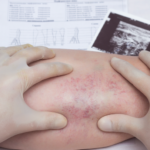
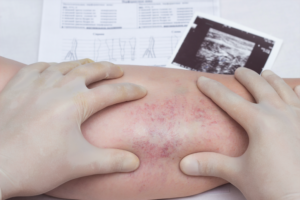
 If you suspect you may have vein issues seeking medical attention as soon as possible is the best way to get your legs back to health.
Surface level veins are pretty easily diagnosed visually but when vein issues are deeper there are certain medical tests and procedures that can be processed when it comes to finding the damage and determining the extent. These same tests can also be used to rule out possible conditions.
If your skin in the area affected is having issues as well it is not unusual for your Dermatologist to work in conjunction with your Vein Specialist.
The Exam
Both standing and seated a visual examination is done on the patients’ legs. Questions will be asked as to how you feel standing, walking, sitting, running, and even while sleeping.
Ultrasound (Duplex)
A duplex ultrasound is a combination of the traditional with the newer technology of the Doppler ultrasound. Traditional ultrasound operates on sound waves in order to create an image of the structures. In this test, you can see the blood vessels and view anything that may be blocking the blood flow.
Doppler ultrasound uses sound waves to create pictures of the movement of the blood. The two together create a picture that can assist your doctor in diagnosing your condition more easily. Your physician may recommend a duplex ultrasound in order to look for blood clots as well.
The Ultrasound Experience
A handheld ultrasound device is placed on your body during this test in the area of suspected issue. It will be moved back and forth over the area. The unit works by sending and receiving sound waves. Those waves are then sent to a computer which will then convert into a visual image of the arteries and veins.
If a diagnosis of vein disease and accompanying varicose veins is made, your doctor will then recommend the very best treatment path possible to get your legs back to health.
Angiogram
If a simple physical exam isn’t enough, an angiogram may be used. During an angiogram, a nonreactive nontoxic dye is injected into your leg veins suspected of sustaining damage. Dying the veins allows the outlines to be viewable on an X-ray image. This is not very commonly used in most exams but can be incredibly valuable if a detailed look at blood flow routes is needed. This test can both confirm a diagnosis of varicose veins or may point to a different condition.
If you are in the Safety Harbor or Tampa, Florida area and in need of a Vein Specialist we hope you consider The West Florida Vein Center. www.westfloridaveincenter.com (727) 712-3233.
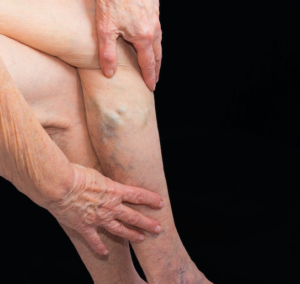 The first thing most people think as they notice their very first spider vein or varicose vein is “Oh no”. The once beautiful skin on their legs is now flawed (or perceived to be so).
 We have all seen it in the faces of serious hardcore lifetime drinkers. The broken capillaries and swelling nasal features, its a telltale sign of the consumption of too much alcohol over time. This excessive consumption can have a negative effect on your entire circulatory system.
 Though you can’t fight genetics the way you live has a major impact on your circulatory systems health and the resulting possibility of vein issues.
 People seem to be turning to yoga classes to help with everything from stress to high blood pressure to even now varicose veins, but does it really work?
 Most of us would never have thought to group the words “Athlete” and “Compression stockings” into one sentence let alone suggest that they might be a good idea to wear during athletic activities. After all, aren’t compression stockings just for little old ladies?
 It’s a fact that as we age our bodies do change. wrinkles and creases may begin to appear, skin loosens, our hair may grey. But what about varicose and spider veins? Many may consider it as well a badge of ageing, but the truth is that spider veins and varicose veins are not simply normal effects of time. They are the result of venous insufficiency. Vein Disease.
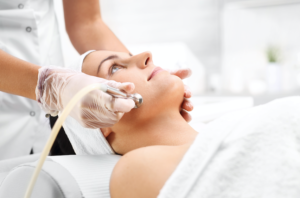 Spider veins are most often thought of as a leg only issue but broken capillaries (spider veins)can form nearly anywhere on a person’s body.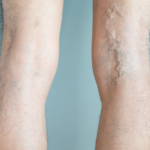
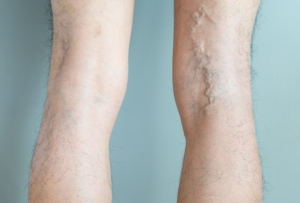 Varicose veins are an issue that most people never talk about.
 A glass or two of wine or beer when out with friends or attending a party doesn’t really make you a “drinker”. Just a social drinker, like most of America. That likely doesn’t have too much of an effect on your veins. But what if it becomes more than occasional or you are a moderate to heavy drinker?